At the Home of Martha and Mary
38 As Jesus and his disciples were on their way, he came to a village where a woman named Martha opened her home to him. 39 She had a sister called Mary, who sat at the Lord’s feet listening to what he said. 40 But Martha was distracted by all the preparations that had to be made. She came to him and asked, “Lord, don’t you care that my sister has left me to do the work by myself? Tell her to help me!”
41 “Martha, Martha,” the Lord answered, “you are worried and upset about many things, 42 but few things are needed—or indeed only one. Mary has chosen what is better, and it will not be taken away from her.”
Luke 10:38-42
This is the short story about Martha and Mary where Jesus comes to visit them. Luke does not name the village Martha and Mary are at, but John tells us that the women reside in Bethany (John 11:1-2; 12:1-3). This is also the place where Jesus raises Lazarus from the dead (John 11:17-44) and where Mary anoints Jesus’ feet with perfume and wipes them with her hair (John 12:1-3).
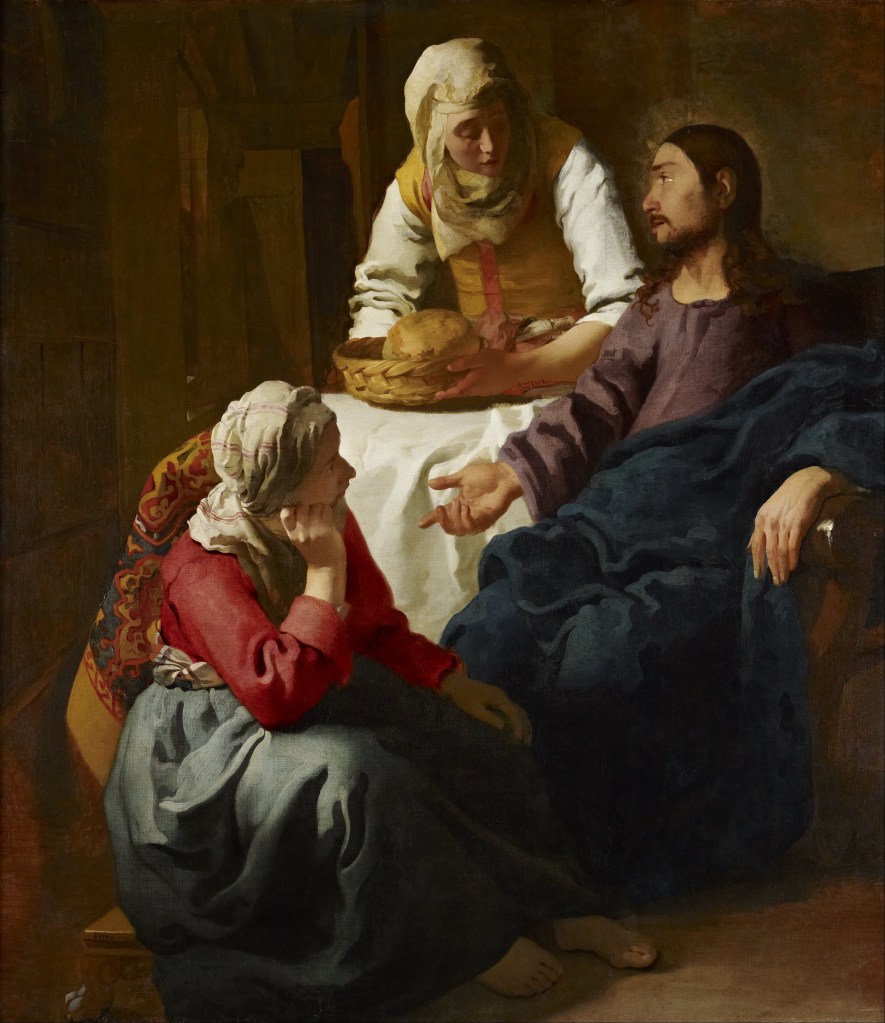
Martha does what is expected of her. She prepares dinner. Mary, on the other hand, is neglecting her rightful responsibilities by not helping make dinner. Martha was bothered by this and her preparations for the meal. She had allowed her duties as hostess to become the priority. Jesus showed concern for Martha’s anxiety, but He did not do what she asked. That is not what He wants. The priority was listening to Jesus’ teachings, which reflects an attitude of dependence. Jesus was telling Martha that the one thing that Mary had chosen was more important than the many things Martha had chosen to do.
This story breaks down social norms at two points:
- There is no reference to a man as the head of this household. Martha welcomes him into “her house” (v. 38) and there . Although Lazarus is the brother of Martha and Mary (John 11:1-2), this story mentions neither Lazarus (the brother of Martha and Mary) nor the male disciples who accompany Jesus.
- Listening to any rabbi was reserved for men only; they understand that sitting at Jesus’ feet wouldn’t be the women position, but here, Mary sits at Jesus’ feet and breaks out of the traditional role and Jesus fully approves, inviting Martha to do the same.
What is the meaning of Jesus’ words to Martha?
The implication was that Martha had lost her perspective of why she was serving in the first place. This passage should be a warning to disciples who tend to be too active in Christian service; busyness, even with legitimate pursuits, can hinder our relationship with Christ. We live in a world that is always so full of distractions and need to pay attention to Jesus with an attitude of dependence on Him.
One interesting take on this story is from Augustine of Hippo who argued that Martha represents the church of the present which will someday pass away. For Augustine, Martha’s decision to toil away in active service is futile because it will no longer be needed after death. On the other hand, Mary’s decision to remain at the feet of Jesus represents the church of the future because being in the presence of Jesus will continue into the next world.
This view places the contemplative lifestyle as better then the active lifestyle. I agree more with Thomas Aquinas who found virtue in both: “There are many arguments to support the position that the contemplative life is superior to the active, but that in some circumstances and in some particular respect, the active life has to be given preference because of the needs of the present life.”
It is important to ask yourself two questions:
- In my relationship with Jesus, am I more of listener or more of a doer?
- Have I lost sight of what is most important in life and am I so busy doing many things that I do not have any time for God?
 Max Murphy